The snowflake
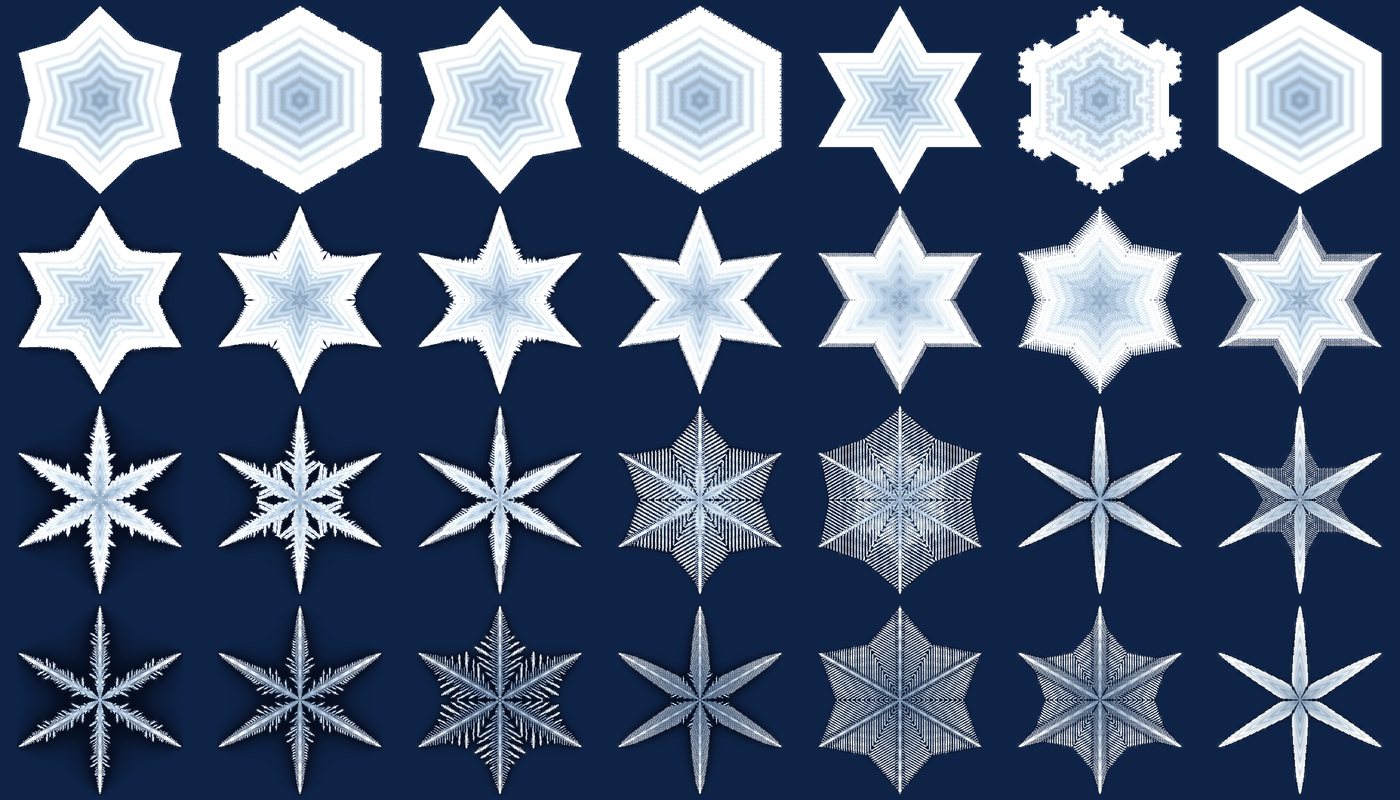
In 1885 Wilson Bentley, a Vermont farmer, became the first person to photograph a single snowflake, and he went on to capture more than 5,000. Here one grows on a grid of hexagons by a simple rule from the mathematician Clifford Reiter. You are the weather: drag the ring across the map while the crystal grows, and its arms record the path you took.
 Drag the ring
The map shows what steady weather grows. Left to right: more vapour in the air. Bottom to top: the ice takes it up faster.
This fern grew in steady weather. Drag the ring and a new crystal starts. Keep moving while it grows.
The rule: every cell of the grid holds some water. A cell holding 1 or more is ice. A cell that is ice, or touches the ice, keeps what it holds, takes in vapour from its neighbours and gains a little more every step (the uptake). In every other cell the vapour spreads, each cell moving halfway toward the average of its six neighbours. Far from the crystal the air always holds the same amount (the vapour). A real snowflake's six arms match because they fall through the same weather together. Here they match for the same reason: one weather, yours, for all six.

Our design The Snowflake is a six-armed ice crystal glowing on deep winter blue: fern-like branches, plates inside plates and bubbles caught in the ice. Printed to order on canvas, posters, tees, hoodies and totes.
What is idealised: this model has no temperature and no falling, only vapour on a flat grid, and the weather changes only when you move the ring. The page works out one twelfth of the crystal and mirrors it, so all six arms match exactly. The colours show when each cell froze, not how a real crystal catches the light.
© 2026 Abidance Technologies Inc. All rights reserved. The designs, this page and its code are ours; please link to it rather than copy it.